I have seen so many people enter the dream of building their own home with a budget calculated based on figures from five years ago. It is a financial disaster waiting to happen. The construction cost per pyeong for country houses has reached a level where common sense and historical averages no longer apply. I personally consulted with a close acquaintance just last month who thought they could build a decent 30 pyeong wooden house for 150 million won. I had to be the one to deliver the harsh news that in 2026, that budget barely covers the raw materials and basic labor for a shell, let alone the finishing touches that make a house a home. The standard market unit prices for construction have risen by nearly 3 percent this year alone according to the Ministry of Land Infrastructure and Transport, and this is on top of the massive surges we saw in 2024 and 2025.
The reality is that building a house in the current economic climate is not about finding the cheapest contractor but about managing inevitable overruns. Construction cost per pyeong for country houses is no longer a fixed number you can just sign a contract for. It is a moving target influenced by global supply chains, strengthened safety regulations, and a labor market that is increasingly facing a qualitative mismatch. If you are not prepared to see your initial estimate grow by at least 15 percent due to fluctuating raw material prices and unforeseen site conditions, you should stop planning immediately. Building a house in 2026 is an exercise in extreme financial discipline and realistic expectations, not just a romantic pursuit of rustic living.
- Critical summary for the 2026 residential building market
- The structural failure of the low cost building myth in 2026
- Analyzing the hidden layers of construction cost per pyeong for country houses
- Hidden expenses that will destroy your 200 million won budget
- Why cheap contractors are a financial suicide mission in 2026
- The harsh reality of insulation and window performance costs
Critical summary for the 2026 residential building market
The minimum realistic starting point for a quality wooden frame house is now 7 million won per pyeong while reinforced concrete starts at 8.5 million won.
Strengthened safety management standards in 2026 have added a mandatory 3 percent increase to all basic construction unit prices.
Invisible costs such as civil engineering, architectural design fees, and landscaping often account for an additional 20 to 30 percent of the total building budget.
The structural failure of the low cost building myth in 2026
The era of the 5 million won per pyeong house is officially dead. I still see advertisements from shady contractors promising these low rates, but you must understand that these are predatory marketing tactics. When you see a low construction cost per pyeong for country houses, you are looking at a house with no insulation, the cheapest vinyl windows, and a foundation that will likely crack within two winters. In 2026, the cost of high strength steel and high performance concrete has stabilized at a very high plateau, making it impossible to build a safe structure at 2019 prices. If a contractor tells you they can build for under 6 million won per pyeong, they are either planning to use inferior materials or they will hit you with massive additional charges halfway through the project.
Why 2026 is the most expensive year to build a home
The 2026 standard market unit prices reflect the higher expenses required for strengthened safety measures at construction sites. This is not just red tape; it is a fundamental shift in how labor is managed. Every public and private project now requires a higher level of safety oversight which translates directly into higher labor costs. Furthermore, the labor market in Korea is currently facing a severe shortage of skilled carpenters and masons, meaning you have to pay a premium to get a crew that actually knows what they are doing. If you hire the cheapest labor, you will spend twice as much later fixing the structural errors they leave behind.
Global supply chain volatility and its impact on your budget
While steel prices have seen a slight cooling due to reduced domestic demand, the export controls on key materials from China have kept the overall materials index high. Timber, which is the backbone of most country houses, remains sensitive to international shipping costs and carbon taxes. When you calculate the construction cost per pyeong for country houses, you are not just paying for wood and nails; you are paying for the global logistics and the geopolitical stability of the materials market. This is why a quote from six months ago is essentially worthless today.
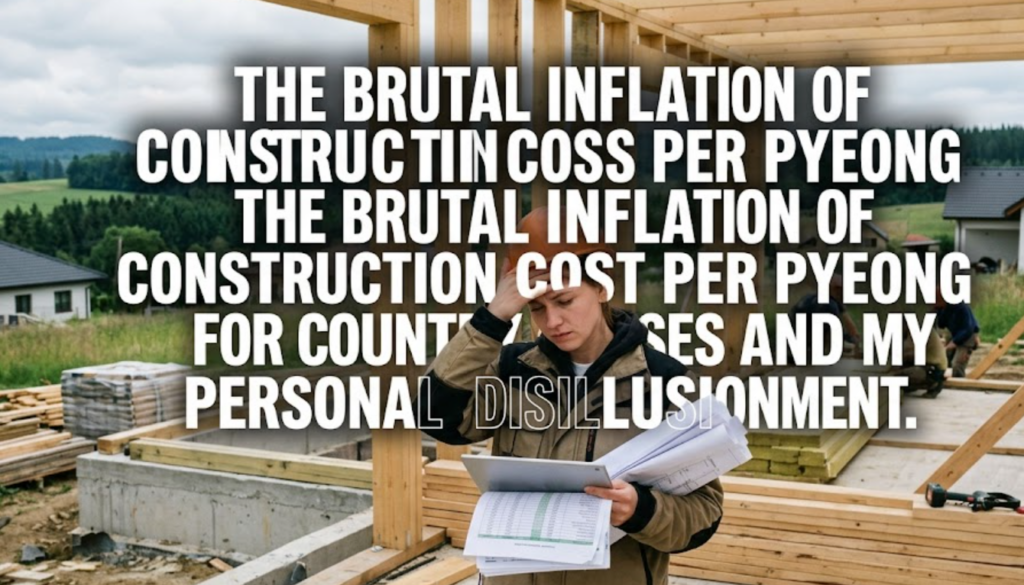
Analyzing the hidden layers of construction cost per pyeong for country houses
When I look at a construction quote, the first thing I check is what is missing. Most people focus on the building itself, but the land prep and the legalities can drain your bank account before you even pour the foundation. The construction cost per pyeong for country houses usually only covers the house from the foundation up. It does not include the 20 to 50 million won you might need for civil engineering if your plot of land is on a slope or has poor soil quality. In 2026, the administrative and permit fees have also seen an uptick to reflect the higher labor costs within architectural firms and local government offices.
| Structural Type | Material Characteristics | 2026 Estimated Cost per Pyeong | Expected Lifespan |
| Reinforced Concrete | High durability and soundproofing | 8.5 to 11 million KRW | 50 plus years |
| Heavy Timber Frame | High aesthetic and earthquake resistance | 8 to 10 million KRW | 40 plus years |
| Light Wood Frame | Fast construction and good insulation | 7 to 8.5 million KRW | 30 plus years |
| Light Steel Frame | Cost effective and fire resistant | 6.5 to 7.5 million KRW | 25 plus years |
| Prefabricated Modular | High precision and shortest timeline | 6 to 7.5 million KRW | 20 plus years |
The analysis of the table above shows that the choice of structure is the single biggest driver of your initial budget. While reinforced concrete offers the best longevity, the construction cost per pyeong for country houses using this method has surged past the 10 million won mark in many premium areas. For most people in 2026, the light wood frame remains the most balanced option, offering decent insulation and a relatively manageable price point. However, even this affordable option has nearly doubled in price over the last seven years. If you choose the prefabricated modular route to save money, be aware that the resale value of these homes is significantly lower because the market still perceives them as temporary structures.
Hidden expenses that will destroy your 200 million won budget
I have seen countless projects stall because the owner ran out of money before the interior was finished. The construction cost per pyeong for country houses is often just the tip of the iceberg. You need to account for the design fee, the supervision fee, and the various taxes that the government will collect. In 2026, the architectural design fee for a custom 30 pyeong house can range from 15 million to 30 million won depending on the complexity and the reputation of the firm. If you try to save money by using a free plan from a construction company, you will likely end up with a house that does not fit your land or your lifestyle.
| Fee Category | Description of Service | 2026 Average Fee Range | Budget Allocation |
| Architectural Design | Custom blueprints and structural calcs | 15 to 35 million KRW | 8 to 10 percent |
| Building Permit | Local government processing fees | 2 to 5 million KRW | 2 percent |
| Civil Engineering | Land grading and retaining walls | 10 to 40 million KRW | 15 percent |
| Construction Supervision | Independent safety and quality checks | 5 to 10 million KRW | 3 percent |
| Utility Connection | Water, electricity, and septic tanks | 7 to 15 million KRW | 5 percent |
The table above highlights why you need a healthy contingency fund. The civil engineering costs are particularly volatile. If your land requires a major retaining wall to prevent landslides, your construction cost per pyeong for country houses effectively jumps by 1 or 2 million won across the entire project. In 2026, the utility connection fees have also increased due to the higher cost of copper for electrical lines and the stricter environmental regulations for septic systems in rural areas. If you do not have at least 50 million won set aside for these non building costs, your project is a financial suicide mission.
Why cheap contractors are a financial suicide mission in 2026
I always tell people that the most expensive house is the one built by the cheapest contractor. In the current market, contractors are squeezed by rising material costs and labor shortages. If a contractor gives you a quote that is 20 percent lower than the market average for the construction cost per pyeong for country houses, they have to make up that difference somewhere. Usually, they do this by skipping the hidden but vital steps, such as proper waterproofing or high quality insulation. By the time you realize the mistake, the contractor is gone, and you are left with a house that leaks every time it rains and costs 1 million won a month to heat.
The scam of the low initial quote
The most common predatory tactic I see in 2026 is the bait and switch. The contractor provides a low construction cost per pyeong for country houses to get you to sign the contract. Then, once the foundation is poured and you are committed, they suddenly discover that the soil is worse than expected or that the price of timber has gone up. They will hold your project hostage until you pay the additional fees. I have seen projects where the final price was 40 percent higher than the initial quote. Always use a standard contract from the Construction Association of Korea and insist on a fixed price for materials where possible.
The qualitative mismatch in the labor market
In 2026, the real problem is not just the cost of labor but the quality. Many experienced artisans have retired, and the younger generation is not entering the trades. This means many crews are now made up of unskilled workers who are supervised by one person who knows what they are doing. This leads to a massive variance in the construction cost per pyeong for country houses because you might be paying for professional labor but receiving amateur results. You must visit the contractor’s previous projects and talk to the owners. If the contractor refuses to give you references, walk away immediately.
The harsh reality of insulation and window performance costs
In the 2026 climate, where we see extreme heat in the summer and severe cold in the winter, the insulation grade is not a luxury; it is a survival requirement. When people try to lower the construction cost per pyeong for country houses, they often start by downgrading the windows. This is the worst mistake you can make. A house with cheap windows is essentially a tent with high walls. You will pay for those cheap windows ten times over in your monthly energy bills. High performance triple pane windows and premium rockwool insulation have become significantly more expensive, but they are the only things that will make your house livable in the long term.
| Component Grade | Material Type | Thermal Efficiency | Cost Impact per Pyeong |
| Basic Grade | Single EPS and Double Glazed Vinyl | Low | Baseline |
| Standard Grade | Dual EPS and Triple Glazed Vinyl | Moderate | Plus 500,000 KRW |
| High Performance | Rockwool and Triple Glazed Aluminum | High | Plus 1.2 million KRW |
| Passive House | Vacuum Insulation and Krypton Windows | Extreme | Plus 2.5 million KRW |
| Eco Friendly | Sheep Wool and Wood Fiber Board | Moderate | Plus 1.8 million KRW |
The analysis of the insulation table proves that you get exactly what you pay for. If you opt for the High Performance grade, your construction cost per pyeong for country houses will increase by about 1.2 million won, but your heating and cooling costs will drop by nearly 60 percent compared to the Basic Grade. In 2026, with energy prices continuing to rise, the payback period for high quality insulation is now less than seven years. For more technical specifications on the latest insulation standards, you can refer to the Korea Institute of Civil Engineering and Building Technology via https://www.kict.re.kr/ where they provide detailed performance data on 2026 certified materials.